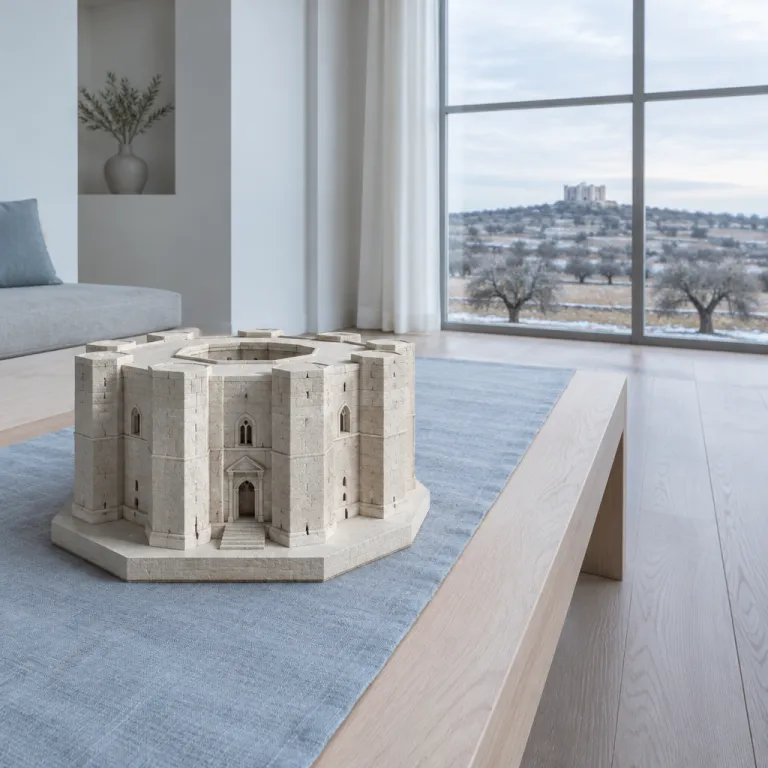
Why Castel del Monte deserves more than a quick coach stop
Most itineraries for a Castel del Monte visit in Puglia allocate barely an hour. That rushed approach flattens a castle conceived with rare intellectual ambition, turning a profound architectural riddle into a simple photo stop. Slow down and the entire Puglia landscape around the castle, from the Murgia plateau to the distant sea haze, begins to frame the experience with quiet drama.
Perched on a low hill near Andria, Castel del Monte is less fortress and more statement piece, its octagonal shape visible from kilometres away across the fields. The castle commissioned by Emperor Frederick II dominates the skyline, yet its relatively compact footprint and two storeys of eight rooms per floor feel almost domestic when you walk inside. Families visiting Puglia who arrive early or late in the day will find space for children to roam the courtyard while adults absorb the building’s fascinating geometry and layered history in peace.
Coach tours tend to treat a visit to Castel del Monte as a box to tick between Bari and Matera. Independent travellers who plan a dedicated day trip, however, can explore how this Puglia castle relates to the wider network of castles built by the Hohenstaufen ruler across southern Italy. When you step away from the groups and trace the line of sight from each tower to the surrounding Murgia, the ordered construction and carefully chosen position begin to feel less like a mystery and more like a manifesto in stone.
The octagonal puzzle and Frederick II’s architectural agenda
Every Castel del Monte visit in Puglia starts with that first encounter with the octagonal courtyard. The octagonal shape repeats obsessively here, from the eight towers to the eight rooms on each floor, and even the internal proportions that scholars still debate. This is where the castle’s architectural language becomes a game that older children and design-minded adults will enjoy decoding together.
Frederick II, often called stupor mundi, ordered construction of this castle not as a conventional hunting lodge or defensive stronghold but as a kind of stone theorem. The Frederick castle project drew on Islamic, classical and northern European references, creating an architectural hybrid that feels unlike other castles in Puglia or beyond. Walk slowly around the courtyard and you will notice how each wall plane, each window and each doorway participates in a strict geometric rhythm that still feels strangely modern.
While some guides still repeat the idea of a pure military function, the stronghold on this hill never had a moat, outer walls or a resident garrison. Instead, the building’s octagonal shape and elevated position suggest a symbolic role, perhaps linked to imperial power, astronomy or philosophy, though no single theory has prevailed. If you are planning a wider cultural itinerary while visiting Puglia, pair this stop with an urban deep dive such as a guide to reading Lecce beyond its baroque postcard image, and you will start to see how Puglia’s architectural history rewards close, unhurried looking.
Light, alignments and the details most visitors never notice
On a typical Castel del Monte visit in Puglia, many groups move through the rooms in under thirty minutes. That pace leaves little time to watch how light enters through the high windows and shifts across the coral breccia stone during the day. Arrive in the quieter months and you will often find entire rooms to yourself, which is when the building’s more subtle fascinations emerge.
Scholars have long noted possible astronomical alignments in the way Castel del Monte is oriented, especially around solstices and equinoxes. Whether or not every theory holds, the ordered construction of windows and portals clearly responds to the sun’s path, creating an ever-changing play of light on each floor that rewards patient observation. Families can turn this into a gentle game, asking children to track how the shadow of a window arch moves along the wall while adults study the architectural detailing around it.
Look closely at the stone itself and you will see veins of coral breccia, a local material that gives the castle its warm, almost flesh-toned glow in late afternoon. In some rooms, traces of decorative elements and lost finishes hint at a more lavish interior before the building was looted century after century. For another perspective on how a single structure can reshape your sense of the region, consider pairing this stop with a half day focused on Otranto’s extraordinary cathedral floor and its Tree of Life mosaic.
Why autumn is the moment for a quiet Castel del Monte visit
For a Castel del Monte visit in Puglia that feels genuinely contemplative, aim for the shoulder season. Autumn brings softer light, cooler air and a noticeable drop in coach traffic, which transforms the experience of this UNESCO heritage site. You will be able to stand in the courtyard or in an upper room without being hurried along by a guided tour, letting the silence do some of the interpretive work.
In these quieter months, the surrounding Murgia landscape feels particularly atmospheric, with long shadows stretching across the fields around the castle. The walk from the car park up to the hilltop becomes part of the ritual, a gentle ascent that gives children space to run while adults take in the full octagonal silhouette against the sky. Visiting Puglia at this time also means you can combine the site with long lunches in nearby masserie, where seasonal menus lean into mushrooms, new oil and robust Castel del Monte wine.
Families staying in luxury properties between Bari and Andria will find that an early morning or late afternoon slot works best, avoiding the middle of the day when any remaining groups tend to cluster. The light at these times flatters the coral breccia walls, emphasising the architectural relief and the subtle colour shifts between blocks that were built in different phases. If you are planning several castles built by Frederick II into one itinerary, autumn’s calmer roads and gentler temperatures make those day trip logistics far more pleasant.
Designing a day trip: routes, nearby towns and wine country
Most travellers fold a Castel del Monte visit in Puglia into a wider day trip that starts or ends in Bari. One elegant route runs from the coast up through Trani, with its waterfront cathedral, then inland to Andria and finally to the Castel del Monte hilltop. This loop keeps driving times manageable for families while still delivering a sense of how the castle once anchored a network of power across the region.
Another rewarding option is to approach from the inland bread capital, using a detailed piece on why Altamura deserves a detour for its bread culture as your planning reference. From Altamura, the road across the Alta Murgia National Park to the Frederick castle site offers wide skies, grazing sheep and a sense of the sparse landscape that shaped imperial hunting lodge traditions. Whichever direction you choose, build in time for a stop at a winery producing Castel del Monte DOC labels, where the silhouette of the Puglia castle often appears on bottles.
Wine estates around Andria and Corato are well set up for tastings that work with children in tow, offering gardens to explore while adults sample structured reds and fresh rosés. A guided tour at one of these properties can illuminate how the same limestone and coral breccia that underpin the castle’s foundations also shape the local terroir. When you return to your hotel, you will find that a glass of Castel del Monte wine on the terrace carries a different resonance once you have walked the floors of the castle itself.
Where to stay: luxury bases for families near Castel del Monte
Choosing the right base can turn a Castel del Monte visit in Puglia from a simple excursion into the anchor of a wider cultural stay. For families, the sweet spot lies in masserie and design-forward hotels within a 30 to 60 minute drive, giving easy access to the castle while preserving a sense of retreat. Properties in the countryside between Bari and Andria work particularly well, combining pool time for children with grown-up wine lists that highlight Castel del Monte labels.
Look for stays housed in historic farmsteads where thick stone walls echo the coral breccia solidity of the UNESCO heritage monument. Many of these properties were built Puglia style, with vaulted ceilings, original floor tiles and shaded courtyards that feel like a softer, more domestic counterpart to the Frederick castle geometry. When a hotel’s team understands both the site’s UNESCO status and the practicalities of visiting Puglia with children, they will help you time your guided tour to avoid crowds and harsh light.
Some masserie offer their own small libraries on regional history, which can be a quiet way to introduce older children to the story of stupor mundi and the castles built under his rule. Others can arrange private transfers, meaning you will not need to manage parking or shuttle logistics on the day trip itself. Ask specifically whether the concierge can secure skip-the-line tickets or a private guide who focuses on the building’s architectural and astronomical aspects rather than a generic military function narrative.
Reading the stones: history, loss and what remains today
By the time you stand in the courtyard on your Castel del Monte visit in Puglia, you are looking at a building that has survived both reverence and neglect. The castle has been used as a prison, stripped of fittings and repeatedly looted century after century, which explains the relative bareness of its interiors today. What remains is the pure architectural skeleton, a clarity that many travellers find unexpectedly moving.
Frederick II built this castle as part of a wider programme of castles built across his southern Italian territories, yet none share quite the same octagonal obsession. The ordered construction, the precise alignment of each floor and the way the octagonal shape governs everything from the courtyard to the towers speak to a mind comfortable with both mathematics and symbolism. When guides mention a possible hunting lodge role or a limited military function, remember that such labels probably capture only a fraction of the building’s original purpose.
As you trace your hand along the coral breccia blocks, you are touching the same material that masons shaped when they built Frederick’s vision on this Murgia hill. The UNESCO heritage designation has ensured careful conservation, but Castel del Monte still feels remarkably unmediated, with minimal signage and a strong sense of open-ended interpretation. That is precisely why visiting Puglia with enough time to linger at this site, rather than rushing through on a coach timetable, will reward travellers who value depth over quantity.
Key figures behind Castel del Monte and its visitors
- Castel del Monte stands at approximately 540 metres above sea level, which gives the castle a commanding view over the Murgia plateau and helps explain its strategic yet symbolic siting (data from Italian geographic surveys, last updated 2023).
- The castle’s plan is based on an octagon with each side measuring about 16.5 metres, while the internal courtyard forms a smaller octagon of roughly 8.5 metres per side, underlining the rigorous geometric concept that defines every floor (measurements published by the Italian Ministry of Culture, 2022).
- Visitor numbers have exceeded 200,000 people annually in recent years, with peak flows concentrated between June and September, meaning that travelling in the quieter months can reduce crowding by more than a third (figures reported by regional tourism authorities in Puglia, 2019–2023).
- Castel del Monte DOC covers around 3,000 hectares of vineyards in northern Puglia, linking the image of the castle to a significant local wine economy that supports dozens of estates around Andria and Corato (data from the Consorzio di Tutela Vini DOC Castel del Monte, 2023).
- The site was added to the UNESCO World Heritage List as a cultural property recognised for its unique blend of classical, Islamic and northern European influences, making it one of fewer than 60 UNESCO heritage sites in Italy with this specific architectural significance (UNESCO World Heritage Centre records, accessed 2024).
FAQ about visiting Castel del Monte in the quiet months
How much time should I plan for a visit with children ?
Families should plan at least two to three hours for a Castel del Monte visit in Puglia, which allows time for the shuttle, the walk up the hill and a relaxed circuit of both floors and the courtyard. This duration gives children space to explore without rushing and lets adults appreciate the architectural details and views. If you add a guided tour or a nearby winery stop, the castle easily anchors a full day trip.
Is a guided tour necessary to understand the castle ?
A guided tour is not strictly necessary, but a knowledgeable guide can illuminate the building’s octagonal shape, possible astronomical alignments and complex history in ways that signage alone cannot. For families, private guides who tailor explanations to different ages work particularly well, keeping younger visitors engaged with stories about Frederick II and his castles built across the region. In the quiet months, guides also have more flexibility to pause in specific rooms and answer detailed questions.
What is the best time of day to avoid crowds ?
In autumn and early spring, the first entry of the morning and the last two hours before closing are usually the calmest for a Castel del Monte visit in Puglia. Coach tours tend to cluster in late morning and early afternoon, so planning around that window will significantly improve your experience. Early or late light also enhances the colour of the coral breccia and the shadows that emphasise the castle’s architectural relief.
Can I combine Castel del Monte with other sites in one day ?
Yes, many travellers combine the castle with Trani, Andria or Altamura in a single day trip, especially when based in Bari or along the nearby coast. Distances are short enough that you can spend several hours at Castel del Monte and still enjoy a long lunch or an afternoon stroll in a historic town. Wine-focused visitors often add a tasting at a Castel del Monte DOC estate, which deepens the connection between the castle’s image and the surrounding landscape.
Are there facilities and services suitable for luxury family travel ?
The immediate site offers basic services, including a ticket office, restrooms and a shuttle running every few minutes between the car park and the entrance, but the wider area between Bari and Andria has an excellent range of high-end masserie and hotels that work well for families. Many properties can arrange private transfers, timed entry tickets and child-friendly guides for your Castel del Monte visit in Puglia. When booking, ask specifically about travel times to the castle and any partnerships with local wineries or cultural guides to streamline your stay.