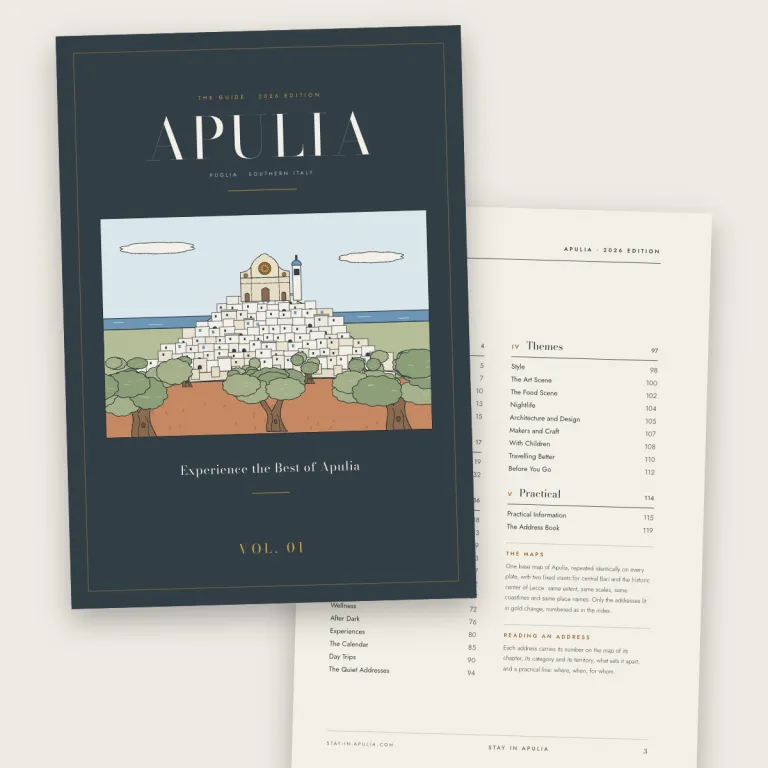
Apulia is the heel of Italy's boot: a long, flat, bright region between two seas, where the most interesting places to sleep are working farms that were once fortresses. That is the first line of our guide, and it is also the problem it tries to solve. About 800 km of coastline wrapped around a plateau of limestone and olive groves, a region that looks small on the map and that most visitors try to cover from a single hotel. The 2026 edition of The Apulia Guide is out, and it starts from there.
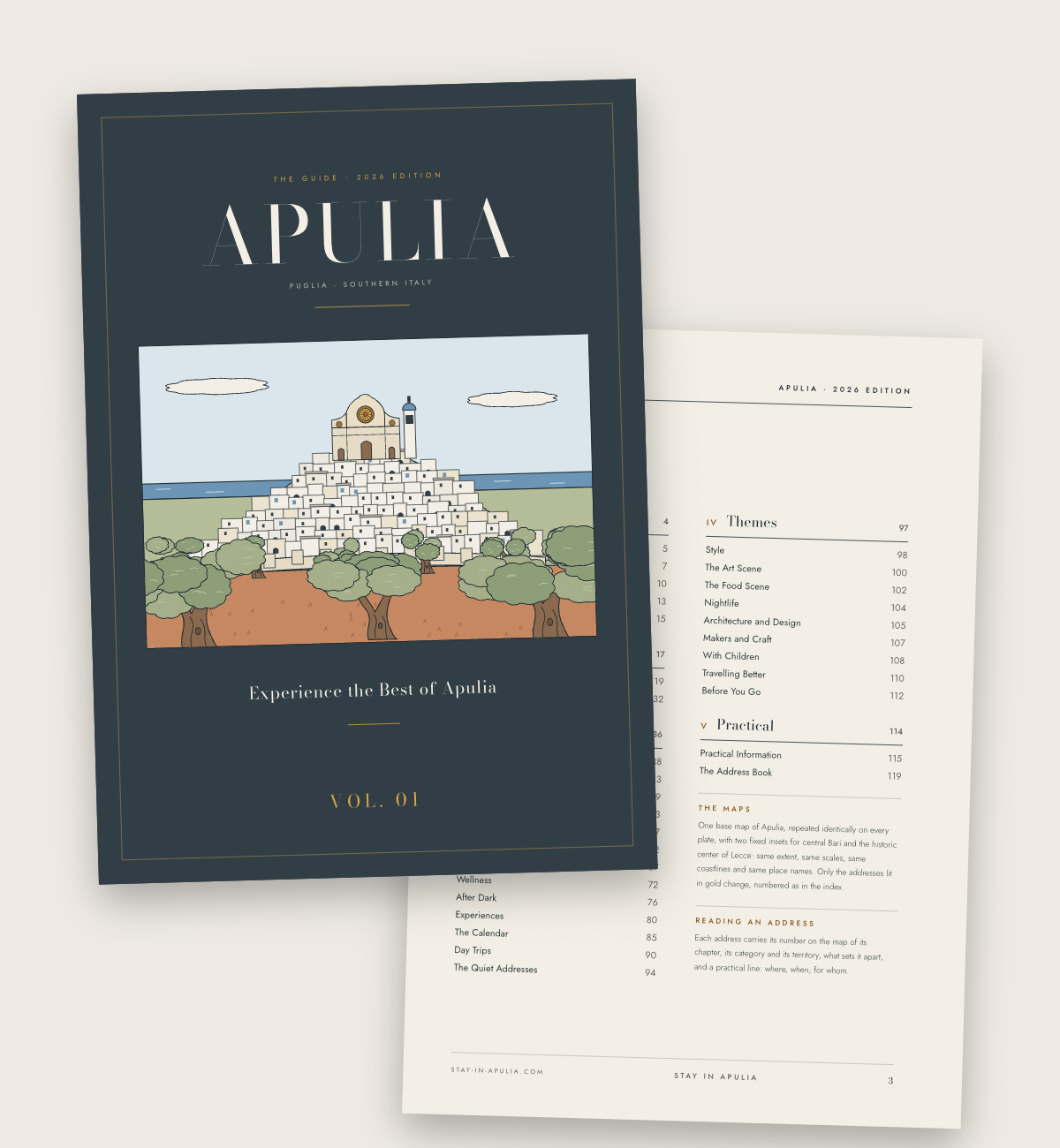
What is inside
121 plates. 103 numbered addresses. 20 maps. 30 illustrations. Three itineraries. Five parts: the opening, the territory, the address book, the themes and the practical chapters.
The address book is the heart of it: 10 places to stay, 12 to eat, 8 to drink, 6 for coffee and early hours, 10 for shopping, 10 for culture and heritage, 8 outdoors, 5 for wellness, 6 after dark, 9 experiences, 8 dated events in the calendar, 6 day trips, and 5 quiet addresses for travelers who already know the region.
Six territories rather than one region
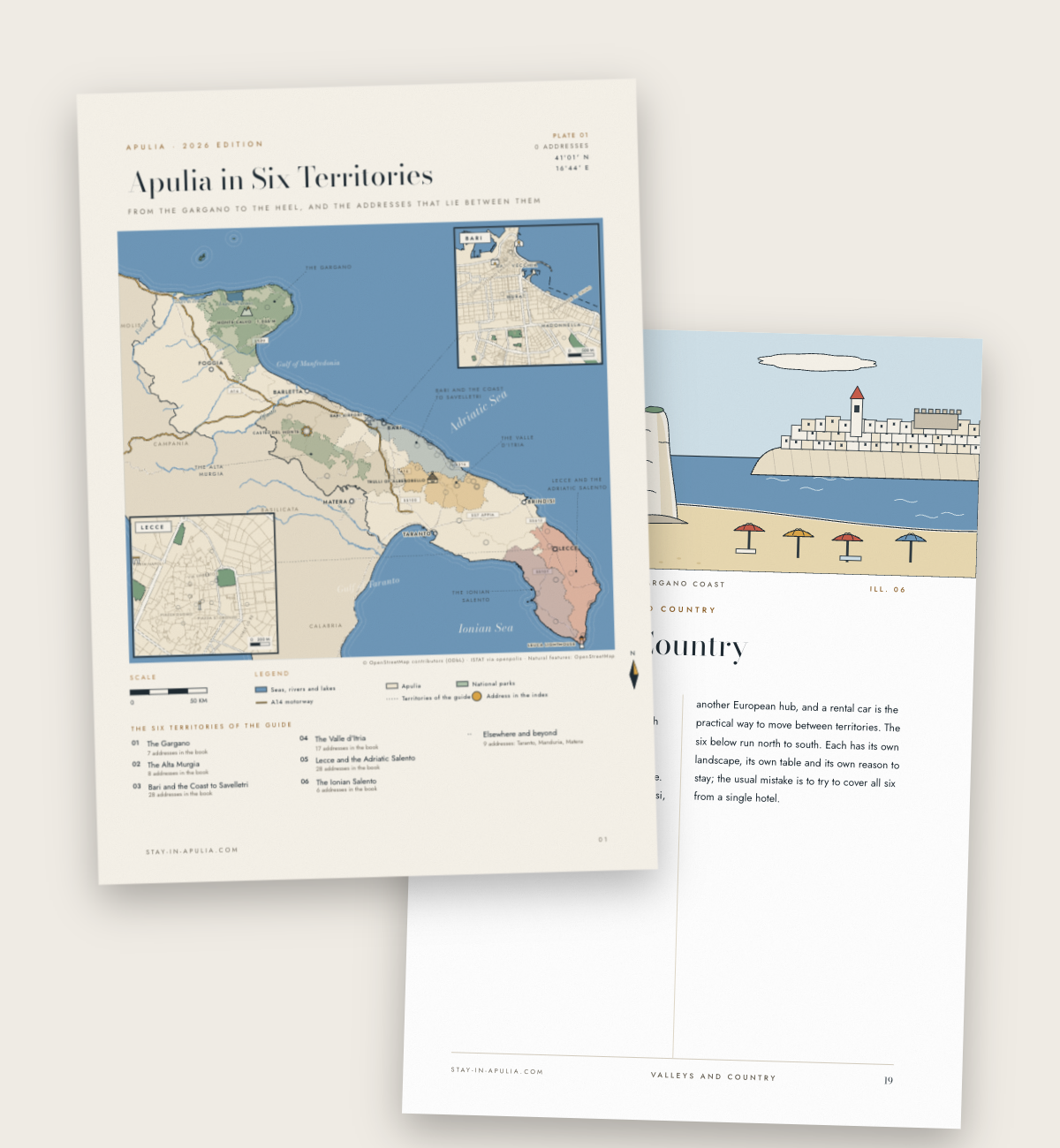
The guide divides Apulia into six territories, and the addresses fall where they really are: 7 in the Gargano, 8 in the Alta Murgia, 28 in Bari and the coast to Savelletri, 17 in the Valle d'Itria, 28 in Lecce and the Adriatic Salento, 6 in the Ionian Salento. Nine more sit elsewhere and beyond: Taranto, Manduria, and Matera across the border in Basilicata.
The guide is blunt about the usual mistake: trying to cover all six from one hotel. Each territory has its own landscape, its own table and its own reason to stay, and the long routes in the book change base accordingly.
20 maps on a single base
Every map in the guide uses the same drawing of Apulia, with two fixed insets for central Bari and the historic center of Lecce: same extent, same scales, same coastlines and place names. Only the addresses lit in gold change, numbered as in the index. One map shows the whole region, one covers each territory, and one opens each chapter of the address book.
Every address says why it is there
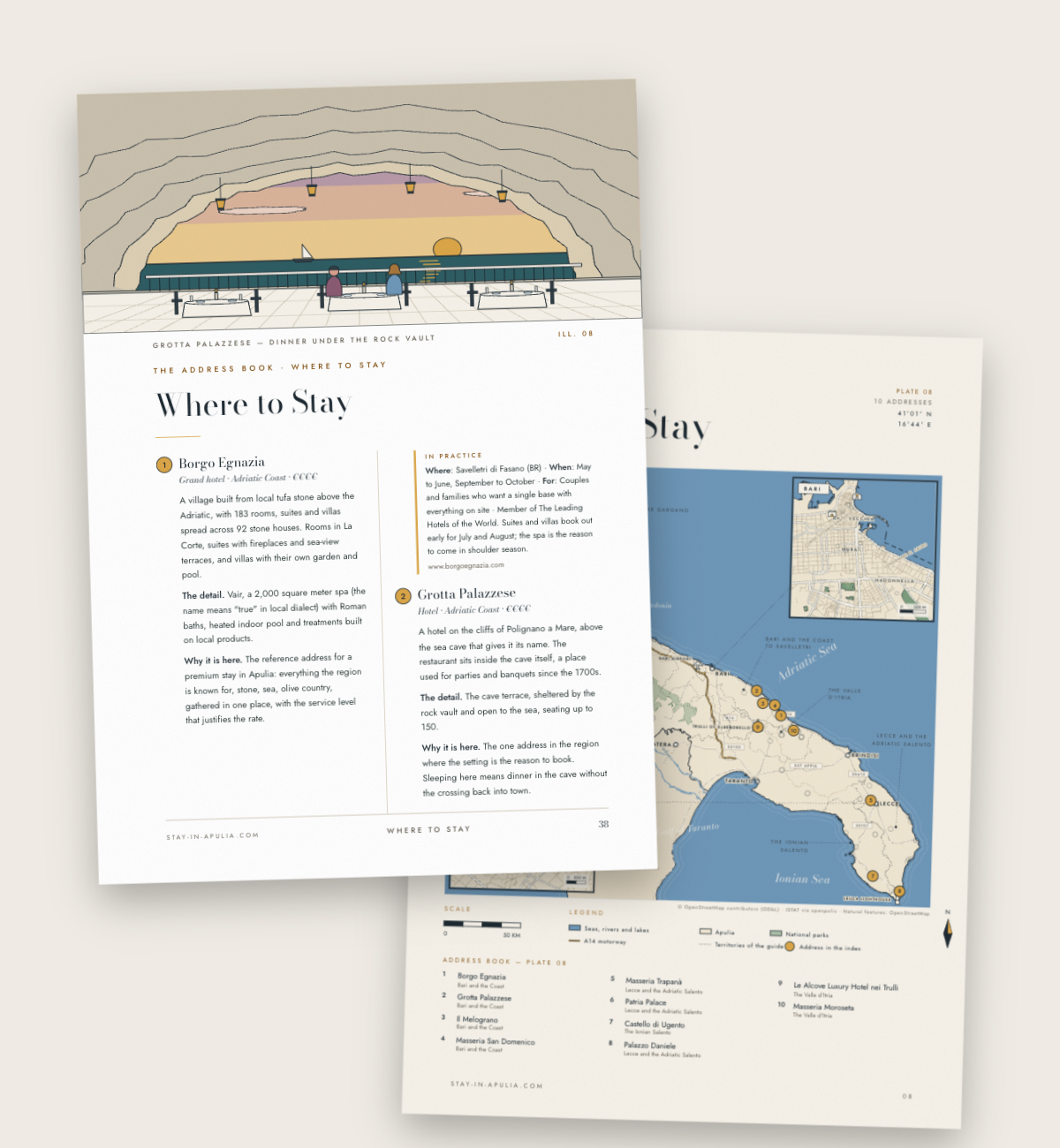
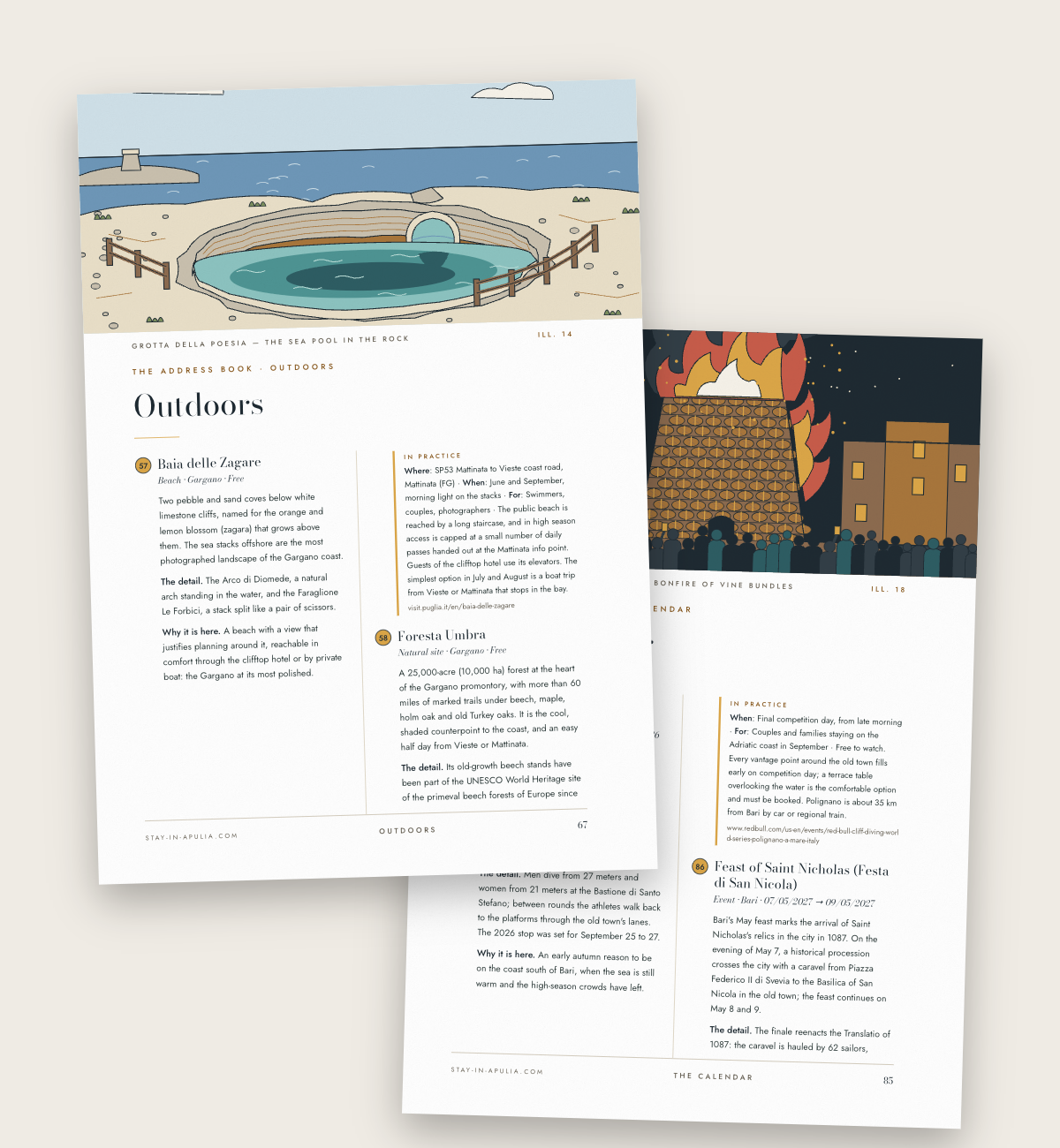
Each entry carries its number, its category and its territory, a detail that sets it apart and a line called "Why it is here", then a practical block: where, when, for whom. Borgo Egnazia opens the Where to Stay chapter: a village built from local tufa stone above the Adriatic, 183 rooms, suites and villas spread across 92 stone houses, and a 2,000 square meter spa. It is the model that reached a world audience in June 2024, when the G7 leaders met there. Number 2, Grotta Palazzese, is the one address in the region where the setting is the reason to book: a hotel on the cliffs of Polignano a Mare, with dinner served inside the sea cave below it.
A guide that kept only resorts would be a list of rates. The book also keeps the masserie that still press their own oil, the village trattorias that need a reservation, and the fishermen's pier at the foot of Bari Vecchia, where the catch is sold off the boats in the morning.
Three itineraries, built only from the guide's addresses
Two days on Bari and the coast to Savelletri, planned from Wednesday to Saturday, because that is when both dinners and the museum on the route are open. Five days in the Valle d'Itria and the Murgia, from one base in the valley, starting on a Tuesday: the Ostuni shops close on Monday and the Cisternino producers work on weekdays. Ten days from Bari to the heel, with a base in the north and a base in the Salento, arriving in Bari and flying home from Brindisi. All three assume a rental car, and all three follow the opening days noted in the address book: shift the start date and you find closed doors along the way.
What it leaves out
Beach clubs that could be anywhere, and the busiest viewpoints at noon in August. It prefers places that can only be seen on their own terms. Gravina Sotterranea, the rooms cut into the rock beneath the old town, opens only on guided tours. The rock churches of Lama d'Antico, a few minutes from the coastal masserie, open from 4 to 8 pm between May 16 and September 30. At Masseria Brancati, below Ostuni, the owner shows olive trees around 2,000 years old and a medieval underground mill, by reservation at least a day ahead. And the WWF reserve of Le Cesine, south of Lecce, can only be entered with a reserve guide.
When to read it
Before you book, not after. Apulia runs on two calendars, the Italian summer that fills the coast and the olive harvest from October, and several of its best addresses keep short seasons, fixed days or appointment-only visits. The guide dates what can be dated, so the trip is built with the calendar rather than against it. It also keeps an eye on the land: since Xylella was identified in the Salento in 2013, the bacterium has killed millions of olive trees, and choosing estates that replant and farm is part of traveling here well. The guide opens in your browser, and it is free.